


 Share on Twitter
 Share on Facebook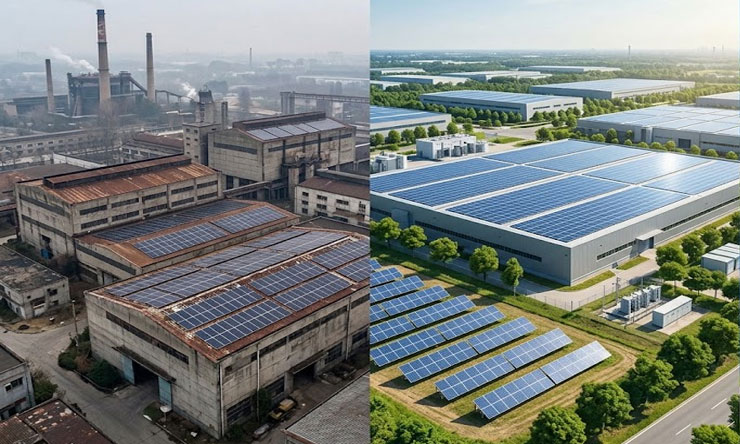
The global energy landscape is undergoing a major transformation as industries face growing pressure to reduce carbon emissions and adopt more sustainable energy sources. Companies are increasingly integrating renewable energy into their operations to support Environmental, Social, and Governance (ESG) objectives while improving long-term energy management. Among the available solutions, modern solar panel technology has emerged as an important option for industrial facilities seeking cleaner and more efficient electricity generation.
Rapid advances in photovoltaic technology have significantly improved the performance of solar panels. Higher conversion efficiency, better cell designs, and stronger module construction allow modern systems to generate more electricity from limited installation areas. These developments make solar power increasingly suitable for factories, warehouses, distribution centers, commercial buildings, and large-scale industrial facilities.
Advances in Modern Solar Panel Technology
Solar panel technology has evolved considerably from earlier generations of photovoltaic modules. Traditional panels offered lower efficiency and were often less effective at maximizing available installation space. Modern modules are designed to capture and convert more sunlight into electricity while improving long-term durability.
One important innovation is bifacial solar technology. Unlike conventional monofacial panels that primarily absorb sunlight from the front side, bifacial modules can capture light from both the front and rear surfaces. The rear side can utilize reflected sunlight from surfaces such as rooftops or the ground. This reflected light, known as albedo, can contribute additional energy production depending on the installation environment.
Another major development is the half-cut cell design. In this configuration, conventional solar cells are divided into smaller sections. This reduces the amount of current flowing through individual cell pathways, which can lower resistive losses and improve overall module performance. Half-cut technology can also provide better performance when part of a panel is affected by shading.
Key Technologies in Modern Solar Modules
Modern solar panels combine several technologies to improve energy output, reliability, and durability. Some of the most relevant components include:
| Technology | Description | Main Benefit |
|---|---|---|
| Bifacial Cells | Capture sunlight from both sides | Potentially higher energy production |
| Half-cut Design | Cells are divided into two sections | Lower losses and improved shade tolerance |
| Multi-busbar (MBB) | Uses multiple thin electrical conductors | Shorter current paths and reduced losses |
| Glass-Glass Structure | Uses glass on both sides of the module | Greater durability in demanding environments |
The combination of these technologies can improve the performance of solar installations. However, the actual energy yield does not depend solely on the panel specification. Factors such as panel orientation, tilt angle, shading, temperature, inverter performance, wiring, mounting systems, and local environmental conditions also influence the overall output.
Solar Power as an Industrial Decarbonization Strategy
Industrial decarbonization involves reducing greenhouse gas emissions associated with manufacturing and other business activities. Since electricity consumption can represent a significant portion of industrial energy use, generating electricity from renewable sources can contribute to broader emission-reduction strategies.
Industrial solar installations can take several forms. Rooftop solar systems make use of existing spaces on factories, warehouses, and other large buildings. Companies with sufficient land may also install ground-mounted solar arrays to achieve larger generation capacities.
Solar power can also provide an additional approach to managing energy costs. Fossil fuel prices and electricity markets can be affected by economic, geopolitical, and regulatory developments. Generating a portion of electricity on-site can provide companies with greater control over part of their energy supply and make long-term energy planning more predictable.
For companies pursuing ESG targets, solar installations can also support environmental objectives. However, the contribution of a solar project should be evaluated using actual electricity consumption, system output, emissions factors, and project conditions rather than relying solely on general sustainability claims.
Maximizing Industrial Space and Energy Production
Industrial facilities often have substantial electricity requirements for machinery, production lines, cooling systems, pumps, lighting, automation equipment, and other processes. Because energy demand can be high, maximizing the available installation area becomes an important consideration.
High-efficiency solar modules allow companies to generate more electricity from a given surface area. Bifacial modules may provide additional benefits in locations where rear-side reflected light can be effectively utilized. Meanwhile, half-cut and multi-busbar technologies can improve the electrical characteristics of the module.
Before installing a solar system, companies should conduct a detailed assessment of their energy requirements. Electricity consumption patterns, peak loads, available rooftop or ground area, shading, roof condition, local climate, and grid requirements should all be considered. This information helps determine an appropriate system capacity and installation configuration.
The Future of Solar Technology in Industry
The development of solar panel technology is expected to continue as manufacturers focus on higher efficiency, improved durability, and better energy yields. Advances in photovoltaic cells are making it possible to produce more electricity without requiring proportional increases in installation space.
Future industrial solar systems are also likely to become increasingly integrated with battery energy storage, digital monitoring, energy management systems, and smart-grid technologies. These technologies can help companies monitor electricity generation and consumption while improving their ability to manage renewable energy.
For industrial businesses, solar power can therefore become more than an environmental initiative. When supported by appropriate technical and financial analysis, it can form part of a broader energy strategy designed to improve efficiency, diversify electricity sources, and support long-term sustainability objectives.
Conclusion
The evolution of solar panel technology has significantly expanded the role of photovoltaic systems in industrial energy management. Innovations such as bifacial cells, half-cut designs, multi-busbar technology, and glass-glass construction provide new opportunities to increase energy production and improve module durability. These developments make modern solar panels increasingly suitable for large industrial applications.
Industrial decarbonization requires careful consideration of technology, economics, operational requirements, and energy consumption patterns. Solar power can contribute to this transition by providing renewable electricity and reducing reliance on conventional energy sources. As photovoltaic technology continues to advance, its integration with energy storage and digital energy management could further expand the role of solar power in the industrial sector.